Light attenuation due to preferential orientation of particles in waves and shear flow: idealized modeling for bacteria, algae, and microplastics
Oct 1, 2025·
,
,
,
,
,
,
,
·
0 min read
Samuel T. Salemink-Harry
Benjamin J. Smith
Hilary A. Dugan
Jennifer A. Franck
Till J.W. Wagner
Lucas K. Zoet
Grace M. Wilkinson
Nimish Pujara
Abstract
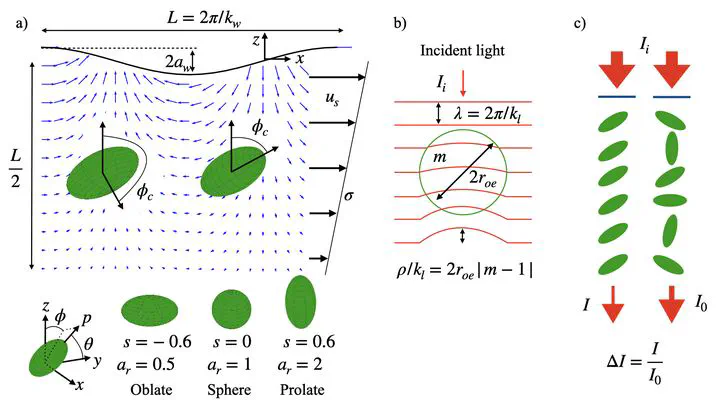
Particles are a key component of aquatic light climate due to their attenuation of light. Near the water surface, waves and sheared currents can induce a preferential orientation of nonspherical particles that alters their inherent optical properties and the associated light attenuation. This modeling study focuses on how particle shape, and the corresponding preferential orientation, impacts the light climate in an aquatic environment. We assume aquatic particles, such as bacteria, algae, and microplastic pollutants, are optically homogeneous spheroids that move with the flow. The model computes their preferential orientations within the upper water column in flow driven by linear water waves and sheared currents. This is combined with the anomalous diffraction optical approximation to examine the effect of particle orientation on the beam attenuation coefficient. We find that the preferential orientation by waves and shear tends to increase the projected area of the spheroid compared to random (isotropic) orientation. This has particle size-dependent effects on light attenuation: for particles comparable in size and shape to algae or microplastics, the preferential orientation corresponds to an increase of 10–25% in the beam attenuation coefficient, whereas there is a decrease of 10–20% in the beam attenuation coefficient for smaller particles comparable in size to bacteria. Overall, our results reveal how preferential orientation of nonspherical particles by waves and currents can impact light climate in the upper water column.
Type
Publication
Limnology and Oceanography